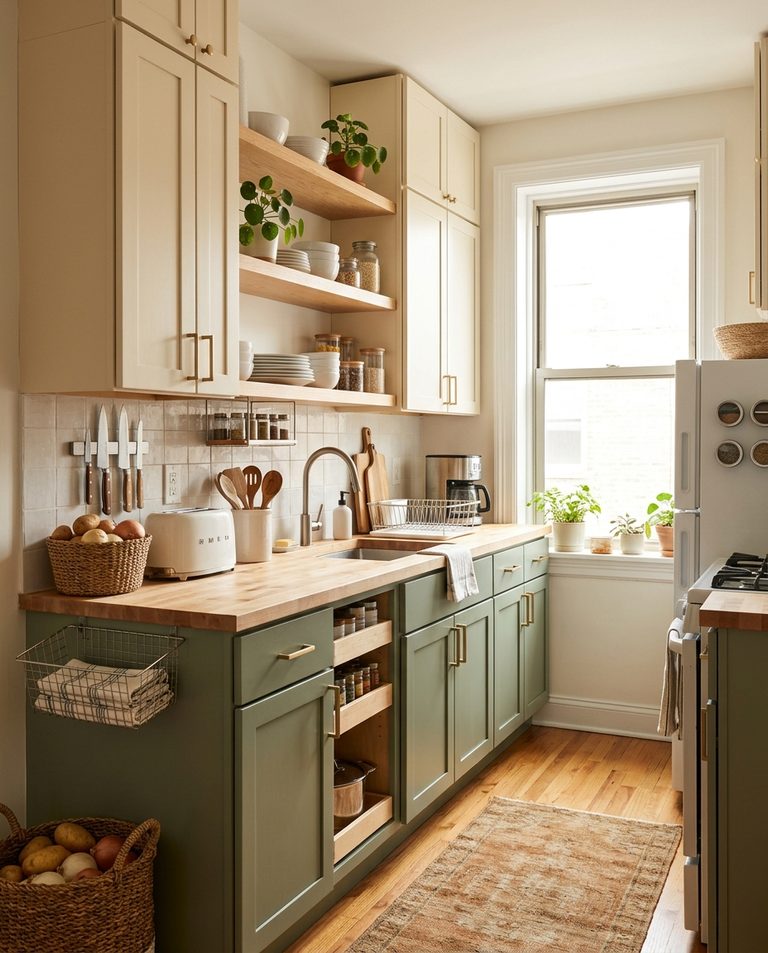
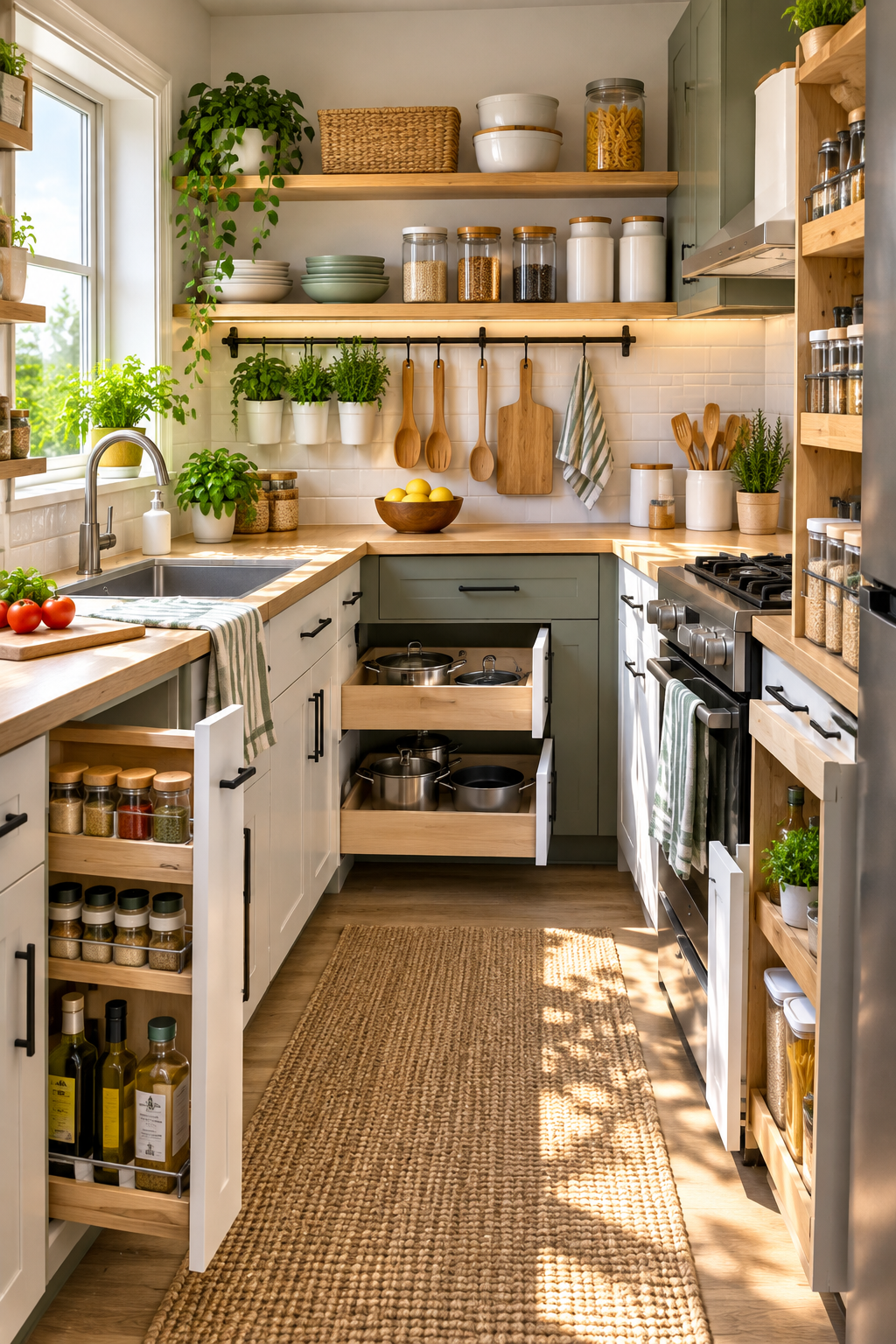
20 Small Kitchen Storage Ideas for More Space
Table of Contents
If you’re looking for small kitchen storage ideas, start by identifying the areas that are currently being wasted rather than buying storage immediately.
The inside of cabinet doors, empty wall sections, unused vertical space, awkward corners, and narrow gaps can all become useful storage areas.
These small kitchen storage ideas focus on practical ways to create more usable space without making the kitchen harder to move around or clean. Whether you live in a small house, apartment, condo, or rental, the goal is to make better use of the kitchen you already have.
1. Add Shelf Risers Inside Cabinets
One of the most practical small kitchen storage ideas for a narrow kitchen is using vertical space instead of adding another wide cabinet.
A shelf riser creates an additional level inside a cabinet, allowing you to separate plates, bowls, mugs, cans, or pantry items instead of stacking everything together.
Before adding one, check the distance between the existing shelf and the top of the cabinet.
Best for: Plates, bowls, mugs, cans, and pantry items.
Trade-off: More levels can improve capacity, but an overfilled cabinet may become harder to access.
2. Use the Inside of Cabinet Doors
The inside of a cabinet door is easy to overlook, yet it can provide useful storage for smaller items.
A slim organizer can hold measuring spoons, kitchen wraps, pot lids, cleaning supplies, or lightweight cooking tools.
Make sure the organizer is shallow enough for the door to close properly and doesn’t interfere with the shelves inside.
Best for: Small tools, wraps, cleaning supplies, and lightweight accessories.
Trade-off: Door-mounted storage may reduce interior clearance and may not be suitable for every rental kitchen.
3. Use Vertical Space With Tall Storage
When floor space is limited, look upward.
A tall, narrow shelf can provide several storage levels while taking up less floor width than a wide cabinet.
Place everyday items lower down and reserve higher shelves for things you use less frequently.
Best for: Pantry items, dishes, appliances, baskets, and cookware.
Trade-off: Upper shelves can be inconvenient if they are difficult to reach.
4. Turn an Empty Wall Into Kitchen Storage
A blank wall can become valuable small kitchen storage when floor space is limited.
Depending on the kitchen and your installation options, you could use shelves, hooks, rails, pegboards, or another wall-mounted system.
Keep frequently used cooking tools close to the area where you prepare food.
Best for: Utensils, mugs, spices, cutting boards, and lightweight kitchen tools.
Trade-off: Open storage needs regular cleaning and can make the kitchen look visually busy when overloaded.
5. Add a Narrow Rolling Cart
A narrow gap beside a cabinet or appliance may be large enough for a rolling cart.
Depending on the design, the cart can hold spices, pantry products, cooking oils, cleaning supplies, or small appliances.
The ability to move it can also make cleaning around the area easier.
Best for: Pantry goods, spices, oils, and cleaning products.
Trade-off: A cart still uses floor space, so make sure it doesn’t interfere with the main walking path.
6. Organize Drawers With Dividers
A crowded kitchen drawer can contain everything you need while still being difficult to use.
Drawer dividers create simple sections for measuring tools, cooking utensils, peelers, gadgets, and other small items.
Avoid creating too many compartments. The goal is to make the drawer easier to use, not more complicated.
Best for: Utensils, measuring tools, peelers, and small kitchen gadgets.
Trade-off: Dividers take up some drawer space, so measure the drawer before buying them.
7. Store Cutting Boards and Baking Sheets Vertically
Flat kitchen items can take up a lot of room when stacked horizontally.
A suitable vertical divider can give each cutting board, baking sheet, tray, or cooling rack its own section.
This also makes individual pieces easier to remove.
Best for: Cutting boards, baking sheets, trays, and cooling racks.
Trade-off: The cabinet needs enough usable space for the items to stand securely.
8. Make Better Use of Corner Space
Corners can become difficult storage areas because standard organizers don’t always fit well.
A corner shelf, compact shelving unit, or appropriately sized organizer can turn an unused corner into useful storage.
Keep frequently used items elsewhere if the corner is difficult to reach.
Best for: Pantry items, small appliances, dishes, baskets, and cookware.
Trade-off: Deep corner storage can cause items to get forgotten, so keep the contents simple.
9. Add a Small Countertop Shelf
If you have a little unused vertical space on the countertop, a small shelf can create another storage level.
Use it for items you reach for regularly, such as spices, mugs, coffee supplies, or small containers.
This can be especially useful when upper cabinet space is limited.
Best for: Spices, coffee supplies, mugs, and small containers.
Trade-off: Countertop storage takes away some workspace, so don’t sacrifice more preparation space than necessary.
10. Organize the Space Under the Sink
The cabinet beneath the sink can be difficult to organize because of pipes and plumbing.
Instead of trying to fill every inch, use smaller bins or organizers that work around the plumbing.
Cleaning products, sponges, trash bags, and dishwashing supplies can be grouped here.
For more ideas, see [Under Kitchen Sink Organization Ideas].
Best for: Cleaning supplies, trash bags, sponges, and dishwashing products.
Trade-off: Keep plumbing accessible and leave enough room to check for moisture or leaks.
11. Use the Side of a Cabinet
An exposed cabinet side can sometimes provide another small storage surface.
Depending on the layout, you could use hooks, a rail, a magnetic organizer, or a shallow shelf.
This works particularly well when the cabinet side faces a workspace rather than a busy walkway.
Best for: Cooking utensils, measuring tools, containers, and kitchen towels.
Trade-off: Too many items can make the kitchen look cluttered.
12. Use the Space Above Upper Cabinets
If there is a gap between the upper cabinets and ceiling, it can provide storage for things you rarely use.
Seasonal serving pieces, occasional-use appliances, and specialty kitchen items can be kept there when appropriate.
Because this area is harder to access and can collect dust, it isn’t ideal for everyday supplies.
Best for: Seasonal items, serving pieces, and occasional-use equipment.
Trade-off: Accessibility and cleaning can be inconvenient.
13. Hang Pots and Pans Where Appropriate
Large cookware can quickly take over an entire cabinet.
If your kitchen has a suitable wall or other appropriate location, a properly installed hanging system can free up some cabinet space.
Make sure the mounting method is suitable for the surface and the weight of the cookware.
Best for: Pots, pans, and selected cookware.
Trade-off: Hanging cookware remains visible and may require more frequent cleaning.
14. Use Narrow Gaps Between Appliances
Small gaps between appliances and cabinets are sometimes wide enough for a slim storage solution.
A narrow organizer can hold spices, oils, baking supplies, or other small kitchen products.
Always check that the organizer won’t interfere with appliance doors, ventilation, electrical connections, or cleaning.
Best for: Spices, oils, pantry items, and small supplies.
Trade-off: Very narrow storage can be difficult to access and may not justify the cost.
15. Organize the Refrigerator Door
The refrigerator door already provides storage, but grouping similar items can make it much more useful.
Keep sauces together, group smaller bottles, and reserve easy-to-reach sections for products you use frequently.
Avoid filling every available space simply because it exists.
Best for: Condiments, sauces, bottles, and smaller packaged foods.
Trade-off: An overloaded refrigerator door becomes harder to clean and maintain.
16. Install a Pegboard for Flexible Storage
A pegboard can turn an empty wall into adjustable storage.
Hooks and accessories can be moved whenever your needs change, making the system useful for cooking utensils, measuring tools, cutting boards, and other lightweight items.
It’s also useful when you don’t want to commit to a fixed arrangement.
Best for: Cooking tools, utensils, measuring equipment, and lightweight accessories.
Trade-off: Installation may not be suitable for every rental, and open storage needs regular cleaning.
17. Use Vertical Containers for Pantry Items
Tall cabinets sometimes have plenty of height but limited usable shelf space.
Suitable containers can help make better use of that vertical area for dry pantry foods such as pasta, grains, or other ingredients.
There is no need to transfer everything into containers. Use them selectively where they actually improve the storage area.
Best for: Dry pantry foods and selected ingredients.
Trade-off: Containers cost money and require maintenance, so choose them for specific storage problems rather than buying them in bulk.
18. Create a Dedicated Appliance Zone
Small appliances can quickly take over both countertops and cabinets.
Instead of spreading them throughout the kitchen, group frequently used appliances in one practical area where possible.
Less frequently used appliances can be stored higher up or in another suitable storage area.
Best for: Coffee makers, blenders, mixers, and other small appliances.
Trade-off: Appliances can still require significant space even when grouped efficiently.
19. Add Hooks for Small Kitchen Items
A few well-placed hooks can provide storage without requiring a shelf or cabinet.
Use them for kitchen towels, measuring cups, lightweight utensils, or other items that are convenient to hang.
Place them where they won’t interfere with cabinet doors or the main walking path.
Best for: Towels, utensils, measuring cups, and lightweight tools.
Trade-off: Always make sure the attachment method is appropriate for the surface and the item’s weight.
20. Move Rarely Used Items Somewhere Else
Sometimes one of the simplest small kitchen storage ideas is to stop storing everything in the kitchen.
If you have another suitable storage area, consider moving holiday serving pieces, specialty cookware, bulk supplies, or rarely used appliances elsewhere.
The kitchen should primarily store the things you actually use there.
This can create additional cabinet capacity without buying another organizer.
Renter-Friendly Small Kitchen Storage Ideas
Renters may have fewer options for permanent shelves, rails, or wall-mounted systems.
Fortunately, many small kitchen storage ideas can work without making permanent changes to the room.
Consider:
- Freestanding rolling carts
- Countertop shelves
- Shelf risers
- Drawer dividers
- Baskets
- Freestanding shelving
- Over-the-door organizers where appropriate
- Removable hooks or organizers when suitable for the surface
Always check your lease before drilling or making permanent changes. For removable products, follow the manufacturer’s instructions and consider the condition of the surface before installation.
For more inspiration, see [Small Kitchen Ideas for Apartments].
Measure Before Buying Storage
An organizer only helps if it actually fits.
Before buying a product, measure the space where you plan to use it.
For cabinets, check the usable interior width, depth, and height. Remember to account for hinges, shelves, and other hardware.
For drawers, measure the inside rather than relying on the outside dimensions.
For narrow gaps, measure the narrowest point and check the full depth and height.
For countertop storage, decide how much workspace you are willing to give up.
For rolling carts and freestanding shelves, check nearby doors and the walking path.
Keeping your measurements on your phone while shopping can help prevent buying storage that doesn’t fit.
How to Choose the Right Small Kitchen Storage Ideas
Not every kitchen needs the same storage solution.
Start by identifying what is actually causing the problem. Is it a lack of cabinet height? Too many cooking tools? Poor drawer organization? Unused wall space? Or simply too many items?
Once you know the problem, choose storage that solves it directly.
For example, shelf risers make sense when cabinet height is being wasted, while drawer dividers are more useful when small tools are difficult to find.
The best small kitchen storage ideas are not necessarily the products with the most compartments. They are the solutions that make everyday items easier to store, access, and put away.
What to Prioritize First
Before buying a large collection of organizers, work through the kitchen in this order:
1. Remove things you don’t use.
Unused appliances, duplicate tools, and rarely used items can take up valuable cabinet space.
2. Check existing cabinets.
Look for wasted vertical space and consider shelf risers or dividers.
3. Improve drawers and cabinet doors.
These areas can often hold more when organized properly.
4. Look at vertical areas.
Check walls, cabinet sides, corners, and other unused surfaces.
5. Deal with awkward gaps.
A narrow gap or under-sink cabinet may be enough for one specific storage solution.
6. Protect your countertops.
Only add countertop storage when the extra capacity is worth the workspace it removes.
7. Buy only what you still need.
Once you identify the remaining storage problem, choosing an organizer becomes much easier.
The goal isn’t to turn every empty surface into storage. It’s to create enough usable capacity for the things you actually need.
The following questions cover some of the most common situations where small kitchen storage ideas can help create more usable space.
Frequently Asked Questions
What are the best small kitchen storage ideas?
Some practical options include shelf risers, cabinet-door organizers, drawer dividers, vertical dividers, rolling carts, wall shelves, and under-sink organizers. The right choice depends on the layout and the type of items you need to store.
How can I add storage to a very small kitchen?
Start by using existing cabinets more efficiently. Then look at overlooked areas such as cabinet doors, empty walls, corners, narrow gaps, and the space under the sink.
How can I create vertical storage in a small kitchen?
Tall shelving, wall-mounted shelves, pegboards, rails, and vertical cabinet dividers can help use unused height. Keep everyday items within comfortable reach and place less frequently used belongings higher up.
What are some small kitchen storage ideas without drilling?
Freestanding carts, shelf risers, drawer dividers, baskets, countertop shelves, and suitable removable organizers can provide additional storage without permanent installation.
How can I get more kitchen storage without losing counter space?
Prioritize cabinets, drawers, cabinet doors, walls, and narrow gaps before using the countertop. If you add countertop storage, keep it limited to items that genuinely benefit from being within reach.
What should I store under the kitchen sink?
Cleaning supplies, dishwashing products, sponges, and trash bags can work well there. Keep the plumbing accessible and avoid packing the cabinet too tightly.
Are rolling carts useful in a small kitchen?
A rolling cart can be useful when there is a genuine unused gap. It can hold pantry products, spices, oils, or cleaning supplies. The main consideration is whether it interferes with the kitchen’s walking space.
How can I organize a small apartment kitchen?
Focus on flexible small kitchen storage ideas such as rolling carts, shelf risers, drawer dividers, baskets, and removable organizers. You can also move rarely used kitchen items to another suitable storage area.
Storage Products Worth Considering
Cabinet shelf risers: Useful when there is unused vertical space inside a cabinet.
Drawer dividers: Helpful for separating utensils and small kitchen tools.
Slim rolling cart: A possible solution for a narrow, usable gap.
Under-sink organizers: Useful for grouping cleaning supplies and dishwashing products.
These products aren’t necessary for every kitchen. Measure first and choose something only when it addresses a specific storage problem.
Final Thoughts
Creating more storage in a small kitchen doesn’t always mean adding another cabinet.
Start with the space you already have. The inside of a cabinet door, unused height above a shelf, an empty wall, a narrow gap, or the area beneath the sink can all become useful storage areas.
Focus first on solutions that are easy to access and maintain. Keep frequently used items within reach, leave enough room to clean, and avoid sacrificing valuable work surfaces simply to add another shelf.
The best small kitchen storage ideas are the ones that give you more usable space without making the kitchen harder to live in.