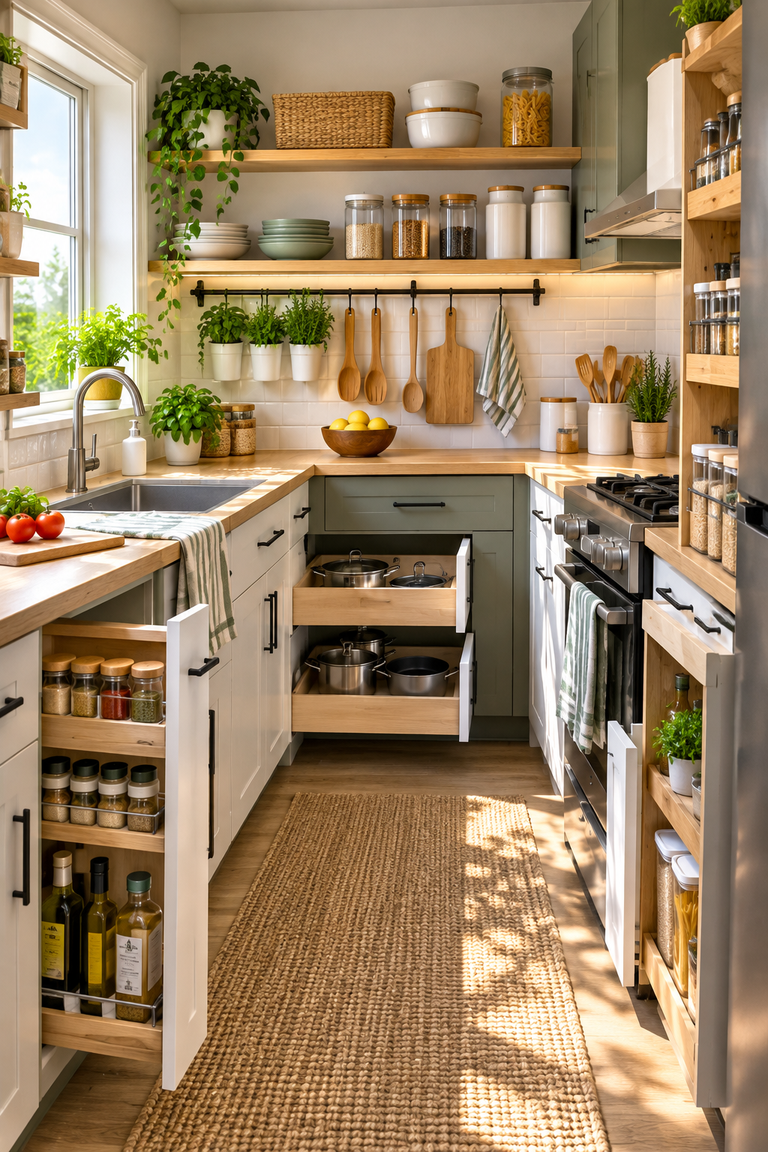
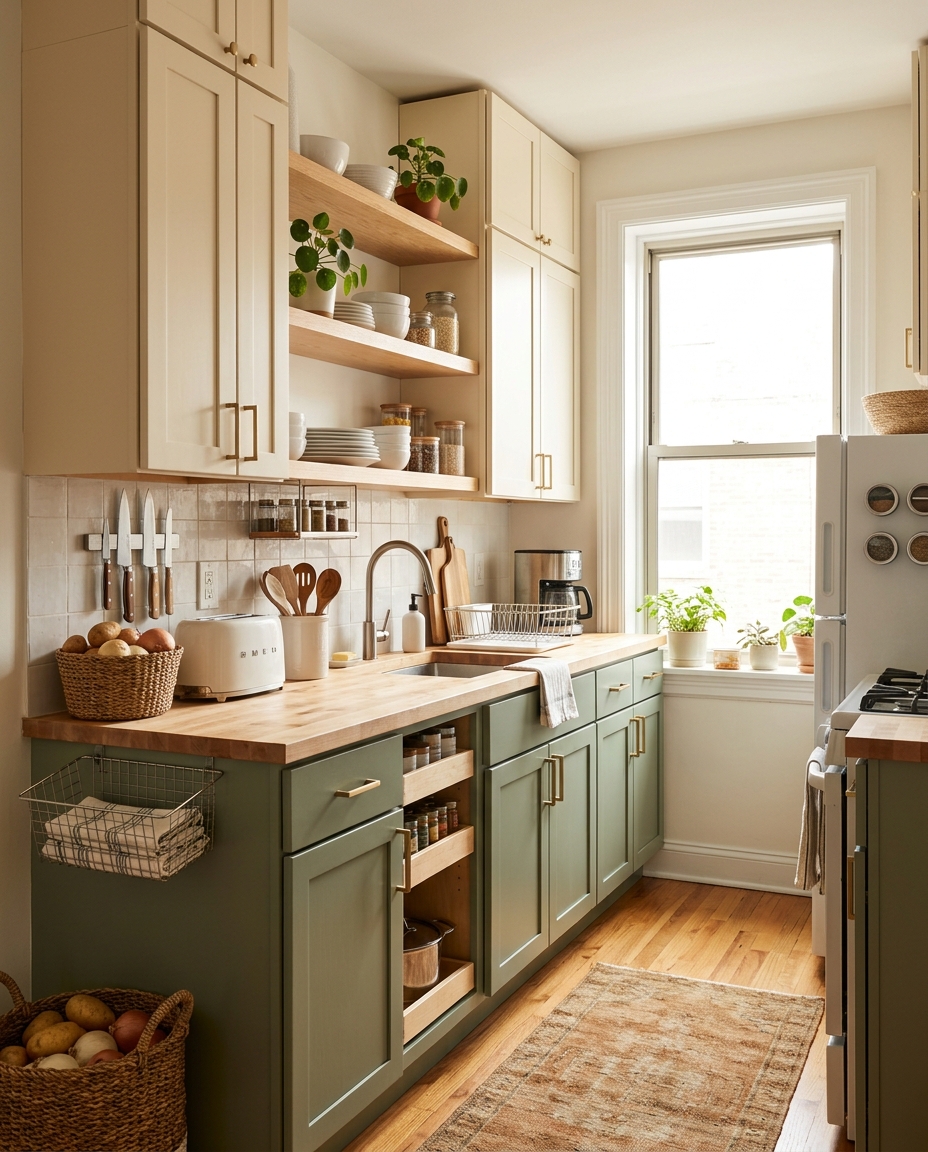
Small Kitchen Organization Ideas That Actually Work
Table of Contents
A small kitchen can become frustrating even when it has a reasonable amount of storage. The problem is often not simply a lack of cabinets. It can be the way everyday items are distributed, how difficult certain things are to reach, or how quickly countertops become cluttered.
The most effective small kitchen organization ideas don’t require you to buy dozens of containers or completely remodel the room. They focus on making better use of what you already have, creating logical zones, and placing frequently used items where they are easiest to access.
Whether you’re organizing a small apartment kitchen, condo, studio, rental, or compact home, these small kitchen organization ideas can help make everyday cooking, cleaning, and putting things away feel more manageable.
The goal is simple: create a kitchen where things are easy to find, easy to use, and easy to return to their proper place.
1. Clear the Countertops Before Organizing Anything
One of the simplest small kitchen organization ideas is also one of the most effective: start with the countertops.
Remove everything that doesn’t genuinely need to remain on the counter.
Keep appliances you use frequently, such as a coffee maker you use every morning. An appliance used only occasionally may be better stored inside a cabinet or another suitable area.
Also remove paperwork, packaging, miscellaneous objects, and duplicate tools that have slowly accumulated.
Clear countertops aren’t just about appearance. They give you more space for preparing food and make the entire kitchen easier to clean.
Quick test: If you haven’t used something on the counter recently, ask whether it really deserves permanent counter space.
2. Organize the Kitchen Around Your Daily Routine
Good small kitchen organization ideas should reflect how you actually use your kitchen.
Think about your normal routine from morning to evening.
Where do you make coffee? Where do you prepare meals? Where do you wash dishes? Where do you store leftovers?
Try to keep the items associated with each activity reasonably close together.
For example, coffee mugs, filters, coffee, and frequently used supplies can be grouped near the coffee maker.
Cooking utensils can stay close to the main preparation area.
Cleaning supplies can remain near the sink.
This approach reduces unnecessary movement and makes the kitchen feel more intuitive.
3. Give Everyday Items the Easiest-to-Reach Locations
One of the most practical small kitchen organization ideas is to organize storage according to frequency of use.
Items you use every day shouldn’t be buried behind things you touch twice a year.
Keep everyday plates, glasses, pans, utensils, and frequently used ingredients in convenient locations.
Less frequently used items can go:
- Higher in cabinets
- Farther toward the back
- In deeper storage
- In less accessible areas
This creates a simple hierarchy that makes the kitchen easier to navigate.
You don’t need to reorganize everything at once. Start with the items you reach for most often.
4. Create Simple Kitchen Zones
Another useful approach to small kitchen organization ideas is dividing the kitchen into functional zones.
You don’t need a huge kitchen to do this.
Consider creating informal areas for:
- Cooking
- Food preparation
- Coffee and breakfast
- Pantry foods
- Dish storage
- Cleaning
- Food storage
These zones don’t need physical boundaries.
The goal is simply to keep related items together.
For example, mixing bowls, measuring tools, and baking supplies can be stored near one another instead of being spread across different cabinets.
This makes the kitchen easier to understand and maintain.
5. Give Every Category a Consistent Home
The best small kitchen organization ideas create consistency.
When every category has a predictable location, putting things away becomes easier.
Possible categories include:
- Everyday dishes
- Cooking utensils
- Pots and pans
- Baking supplies
- Pantry foods
- Food storage containers
- Cleaning products
- Coffee and tea
- Small appliances
You don’t need a separate cabinet for every category.
Several related categories can share a space.
What matters is that everyone using the kitchen knows where things belong.
6. Use Shelf Risers Inside Tall Cabinets
If a cabinet has a lot of unused vertical space, a shelf riser can create another level.
This is one of the simplest small kitchen organization ideas for making existing cabinets easier to use.
Instead of stacking plates, bowls, mugs, or cans into one tall pile, you can separate them into two levels.
Before buying a riser, measure the usable cabinet width, depth, and height.
Make sure the added level doesn’t make everyday items harder to reach.
Best for: Plates, bowls, mugs, cans, and pantry containers.
Trade-off: A riser improves vertical space, but an overcrowded cabinet can still be difficult to use.
7. Organize the Area Under the Kitchen Sink
The cabinet under the sink often becomes a random collection of cleaning products.
A better system is to group similar items together.
For example:
- Dishwashing supplies
- Surface cleaners
- Sponges and brushes
- Trash bags
- Extra cleaning products
Use small bins if they genuinely make the area easier to manage.
Don’t fill the cabinet with containers simply because they look organized.
Keep plumbing accessible and leave enough room to inspect the cabinet for moisture or leaks.
For more ideas, see [Under Kitchen Sink Organization Ideas].
8. Use Drawer Dividers for Small Tools
Drawers can become difficult to manage when measuring spoons, peelers, spatulas, bottle openers, and other tools are mixed together.
Drawer dividers are among the most practical small kitchen organization ideas when small items constantly get lost.
Create broad categories rather than too many tiny compartments.
For example, you could have one section for measuring tools, one for cooking utensils, and another for small gadgets.
The goal is to make everything visible and easy to return.
9. Store Cutting Boards and Baking Sheets Vertically
Flat kitchen items often become frustrating when they’re stacked horizontally.
A suitable divider can allow cutting boards, baking sheets, trays, and cooling racks to stand vertically.
This makes individual items easier to retrieve because you don’t have to lift an entire stack.
Vertical storage is especially useful when a cabinet has enough height but limited horizontal space.
Before purchasing a divider, measure the cabinet and check that the items can stand securely.
10. Use the Inside of Cabinet Doors
The inside of a cabinet door is often unused.
That makes it an interesting option for small kitchen organization ideas involving smaller items.
Depending on the cabinet, the door may hold:
- Measuring spoons
- Kitchen wraps
- Pot lids
- Lightweight tools
- Cleaning supplies
Choose a slim organizer that allows the door to close completely.
Also check that it won’t interfere with shelves or items stored inside.
For rental kitchens, make sure the installation method is appropriate for the surface and allowed under the lease.
11. Use Empty Walls Selectively
When cabinets are limited, look at your walls.
A suitable rail, pegboard, shelf, magnetic system, or hooks can move selected items away from drawers and countertops.
However, not every empty wall needs to become storage.
This is an important principle behind effective small kitchen organization ideas: use additional storage only when it solves a genuine problem.
Keep frequently used tools near the area where they’re needed.
Also consider cleaning. Open storage can collect grease and dust, especially near cooking areas.
12. Organize Pots and Pans According to Use
Pots and pans can quickly consume an entire cabinet.
Instead of trying to force everything into one arrangement, organize cookware according to how often you use it.
Everyday pans should be easy to reach.
Occasional cookware can be stored farther back or in a less convenient cabinet.
Compatible pots can sometimes be nested together, while lids can be stored separately if that makes retrieval easier.
For flat cookware such as baking sheets, vertical dividers may work better than horizontal stacks.
The best small kitchen organization ideas adapt to your actual cookware instead of forcing every kitchen into the same system.
13. Create a Dedicated Pantry Zone
You don’t need a separate pantry room to create an organized food-storage area.
Choose one cabinet, shelf, cupboard section, or rolling cart and make it your main pantry zone.
Group similar foods together:
- Pasta and grains
- Canned foods
- Baking ingredients
- Breakfast foods
- Snacks
- Cooking ingredients
Keeping categories together makes it easier to see what you have and can reduce accidental duplicate purchases.
For more inspiration, see [Small Pantry Organization Ideas].
14. Use Containers Only When They Solve a Problem
Matching containers can make a pantry look neat, but they aren’t automatically necessary.
Good small kitchen organization ideas should make everyday life easier rather than create more maintenance.
Use containers when they improve visibility, contain loose ingredients, or make a particular cabinet easier to use.
If an item is already easy to identify and store in its original packaging, there may be no reason to transfer it.
Don’t buy twenty containers simply because an organized pantry photo looked attractive online.
Start with the problem.
Then choose a solution.
15. Create a Coffee and Breakfast Zone
If your morning supplies are spread throughout the kitchen, create one practical coffee or breakfast area.
Keep commonly used items together, such as:
- Coffee maker
- Coffee or tea
- Mugs
- Filters
- Spoons
- Frequently used breakfast supplies
Some items can remain on the counter while others can be stored in the cabinet above or below.
This is one of the small kitchen organization ideas that can make a daily routine noticeably simpler without requiring additional storage furniture.
16. Store Appliances According to Frequency of Use
Small appliances can consume valuable cabinet and countertop space.
Instead of treating every appliance equally, organize them according to how often you use them.
Daily appliances should remain accessible.
Weekly appliances can go into convenient cabinets.
Occasional appliances can be stored higher, deeper, or somewhere else in the home if appropriate.
If an appliance is rarely used and takes up a large amount of space, consider whether it actually needs to remain in the kitchen.
This is an important part of small kitchen organization ideas because reducing unnecessary storage pressure can be more effective than buying another organizer.
17. Use Narrow and Awkward Spaces Intentionally
Small kitchens often have unusual gaps between cabinets, appliances, and walls.
A narrow gap might accommodate a slim rolling cart.
An exposed cabinet side could hold a few lightweight items.
A corner might work for a small shelf.
But don’t automatically fill every available gap.
One of the smarter small kitchen organization ideas is to ask whether the space can solve a real problem before adding anything.
A storage solution isn’t useful if it blocks a walkway or makes an appliance difficult to operate.
18. Organize the Refrigerator Door
The refrigerator door can become difficult to manage when everything is placed randomly.
Group similar items together.
For example:
- Sauces together
- Smaller bottles together
- Frequently used condiments in easy-to-reach areas
Avoid filling every shelf simply because there is room.
The refrigerator should remain easy to clean and items should remain visible.
The same principle applies to many small kitchen organization ideas: available space isn’t automatically useful space.
19. Create a Simple System for Food Storage Containers
Food storage containers can quickly become one of the most frustrating categories in a small kitchen.
Keep containers together rather than spreading them across several cabinets.
If possible, separate containers from lids or organize them in a way that makes matching pieces easy to find.
Remove damaged or rarely useful pieces when appropriate.
The goal isn’t to create a perfect container collection.
It’s to make it easy to grab the right container and put it away afterward.
20. Make the Organization Easy to Maintain
The final principle behind successful small kitchen organization ideas is maintenance.
A system that looks perfect on the first day but becomes frustrating after a week isn’t a useful system.
Keep frequently used items simple to return.
Avoid overfilling cabinets.
Leave enough space to see what you own.
Clean areas that collect grease, crumbs, and spills.
And make small adjustments when you notice something repeatedly ending up in the wrong place.
Good organization should become part of the kitchen routine.
Small Kitchen Organization Ideas for Apartments and Rentals
Apartment kitchens and rental kitchens often have limited cabinets, unusual layouts, or restrictions on permanent modifications.
That doesn’t mean you can’t create an efficient system.
Many small kitchen organization ideas can be adapted using flexible solutions such as:
- Freestanding carts
- Shelf risers
- Drawer dividers
- Baskets
- Countertop shelves
- Removable organizers
- Freestanding shelving
- Suitable hooks
Before drilling into a wall or cabinet, check your lease.
Also consider portability. If you move frequently, a freestanding organizer that can move with you may be more practical than a permanent installation.
For more ideas, see [Small Kitchen Ideas for Apartments].
Small Kitchen Organization Ideas Without Remodeling
You don’t need a renovation to improve how your kitchen works.
Start with the storage you already have.
Clear unnecessary countertop items.
Rearrange cabinets according to frequency of use.
Group related categories.
Use drawer dividers where necessary.
Create a pantry zone.
Move rarely used appliances away from prime storage locations.
These simple small kitchen organization ideas can change the way a kitchen functions without replacing cabinets or changing the layout.
The key is to solve organization problems before trying to solve them with new products.
How to Decide Where Something Belongs
When you’re unsure where to store an item, ask three questions.
How often do I use it?
Daily items should be easiest to reach.
Where do I use it?
Whenever practical, store an item close to the activity it supports.
What belongs with it?
Group related items together so you don’t have to search multiple cabinets.
These questions can guide many small kitchen organization ideas without requiring expensive products.
They also make the system easier for other people in the household to understand.
Measure Before Buying Kitchen Organizers
One common mistake is buying an organizer based on the space you can see rather than the space you can actually use.
Before purchasing anything, measure:
- Cabinet width
- Cabinet depth
- Cabinet height
- Drawer interior dimensions
- Countertop depth
- Available wall space
- Walking clearance
- Door and drawer clearance
For cabinets, remember to account for hinges and fixed shelves.
For narrow carts, measure the narrowest point of the gap.
For countertop organizers, consider how much workspace will remain.
Measurements are an important part of small kitchen organization ideas because even a good organizer can become a problem when it doesn’t fit correctly.
A Simple Weekend Plan for Organizing a Small Kitchen
You don’t need to reorganize your entire kitchen in one day.
Use this simple process.
Step 1: Clear the countertops
Remove everything that doesn’t need permanent counter space.
Step 2: Choose one cabinet
Take everything out and group items by category and frequency of use.
Step 3: Organize one drawer
Remove duplicates and create simple sections.
Step 4: Create a pantry zone
Put similar dry foods together.
Step 5: Organize under the sink
Separate cleaning supplies and leave the plumbing accessible.
Step 6: Choose one overlooked area
Look at a cabinet door, wall, corner, or narrow gap.
Step 7: Identify remaining problems
Only after reorganizing should you decide whether you actually need an additional organizer.
This process is more sustainable than buying storage products first and trying to find somewhere to put them later.
Common Small Kitchen Organization Mistakes
Even well-intentioned small kitchen organization ideas can create problems when they’re taken too far.
Overfilling every cabinet
More items inside a cabinet don’t necessarily mean better organization.
Keeping everything on the counter
Easy access is useful, but too many items can reduce your workspace.
Buying organizers before measuring
A product that doesn’t fit is simply another source of clutter.
Creating too many categories
Organization should simplify your kitchen, not turn every drawer into a complicated system.
Storing rarely used items in prime locations
Your best storage areas should generally serve the things you use most.
Making every surface productive
Not every empty wall or corner needs storage.
Leaving some open space can make the kitchen easier to use and maintain.
Frequently Asked Questions
What are the best small kitchen organization ideas?
The most useful small kitchen organization ideas usually start with removing unused items, clearing countertops, grouping related categories, improving cabinet layouts, and keeping everyday items within easy reach.
How do I organize a very small kitchen?
Start with decluttering, then organize your kitchen around daily routines. Keep frequently used items accessible, group similar items together, and use vertical or overlooked spaces only when they solve a genuine problem.
How can I organize a small kitchen without remodeling?
You can improve many kitchens with shelf risers, drawer dividers, baskets, rolling carts, removable organizers, and better placement of existing items.
What are some small kitchen organization ideas for renters?
Useful small kitchen organization ideas for renters include freestanding carts, shelf risers, drawer dividers, countertop shelves, baskets, and removable organizers. Always check your lease before making permanent changes.
How do I keep my small kitchen countertops organized?
Keep only frequently used appliances and essential items on the countertop. Give everything else a specific home inside a cabinet, drawer, pantry area, or another suitable storage location.
How should I organize a small kitchen pantry?
Group similar foods together and keep frequently used ingredients easy to reach. Use containers selectively when they make the pantry easier to see and maintain.
How can I organize pots and pans in a small kitchen?
Keep frequently used cookware accessible and store less frequently used pieces farther away. Nest compatible pots when practical and consider vertical dividers for flat pans and baking sheets.
How can I make a small kitchen easier to maintain?
Keep the organization system simple. Items should have obvious homes, frequently used belongings should be easy to return, and storage areas shouldn’t be packed so tightly that they become difficult to clean.
Affiliate Disclosure
Living in Less may earn a commission if you purchase a product through an affiliate link, at no additional cost to you. We only include affiliate recommendations when a product category can genuinely help with the organization problem being discussed.
Product availability, features, and pricing can change, so check the retailer’s current information before purchasing.
Useful Products to Consider
Shelf risers: Helpful when cabinets have unused vertical space.
Drawer dividers: Useful for separating small kitchen tools.
Slim rolling carts: Helpful when a kitchen has a suitable narrow gap.
Under-sink organizers: Useful for grouping cleaning supplies.
These products aren’t necessary for every kitchen. Measure first and choose an organizer only when it solves a specific problem.
Final Thoughts
A well-organized kitchen isn’t necessarily one where every cabinet looks perfect.
It’s a kitchen where the things you use regularly are easy to find, countertops remain functional, and everything has a logical place to return to.
Start by removing what you don’t need. Then organize around your daily routines, group related items, and give frequently used belongings the easiest locations.
Use additional organizers only when they solve a specific problem.
The best small kitchen organization ideas are not complicated systems. They are practical habits and simple arrangements that make cooking, cleaning, and putting things away easier every day.