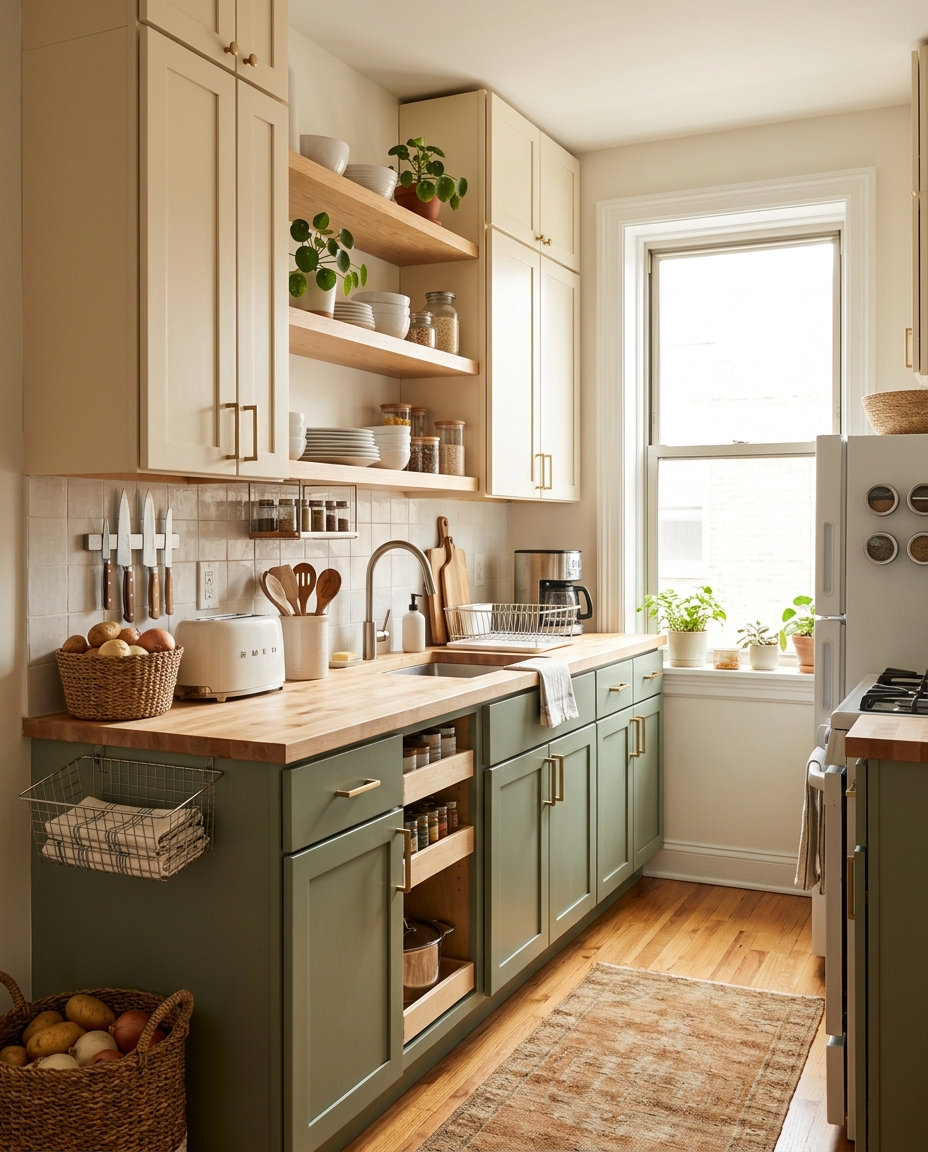
Small Kitchen Organization Ideas That Actually Work
Small Kitchen Organization Ideas
A small kitchen doesn’t need to hold less just because it has less space. It needs a setup that makes better use of the space you already have.
When counters become storage areas and cabinets are packed so tightly that you can’t see what’s inside, even simple cooking tasks can become frustrating. The solution isn’t always buying more organizers. Sometimes it’s moving things to a better location, getting rid of duplicates, or using a space that has been overlooked.
These small kitchen organization ideas focus on practical changes you can make in an apartment, condo, studio, rental, or small home. The goal is straightforward: make everyday items easier to find, easier to put away, and less likely to take over your kitchen.
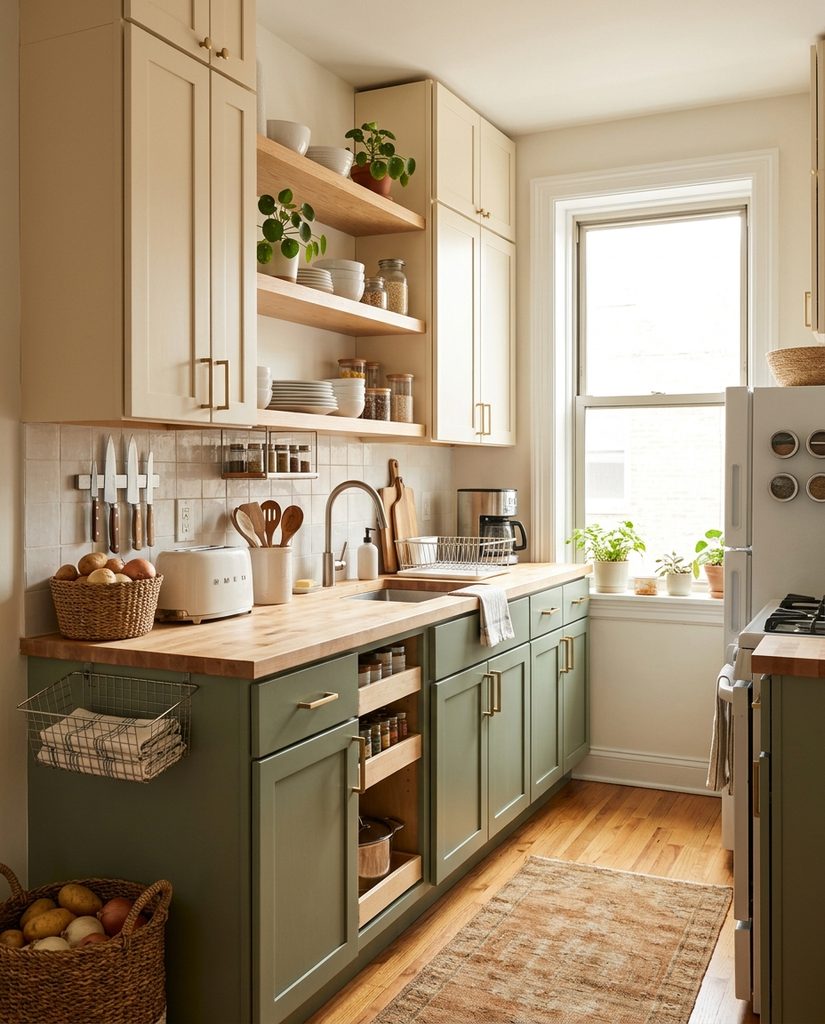
1. Clear the Countertops First
Before adding storage, look at what’s currently living on your countertops.
Keep out the appliances and tools you use regularly. Everything else should have a designated storage spot if possible.
For example, a coffee maker you use every morning may deserve permanent counter space. A blender you use once a week might be better stored in a cabinet.
This is one of the simplest forms of countertop organization because it doesn’t require buying anything.
The benefit isn’t just visual. Clearer counters give you more usable workspace when you’re preparing food.
2. Give Everyday Items the Easiest-to-Reach Spots
The things you use every day shouldn’t be hidden behind things you rarely touch.
Keep frequently used plates, glasses, pans, knives, cooking utensils, and coffee supplies in locations that are easy to reach.
Less frequently used items can go higher up, farther back, or in harder-to-reach cabinets.
This simple change can make a small kitchen feel more functional because you’re not constantly moving other things out of the way.
3. Use Cabinet Risers to Create Another Level
A tall kitchen cabinet can contain a lot of unused vertical space.
A shelf riser can create a second level for plates, bowls, mugs, cans, or other items.
Instead of stacking everything into one tall pile, you can separate it into two easier-to-access sections.
Before buying a riser, measure the inside width, depth, and height of the cabinet.
Best for: Plates, bowls, mugs, cans, and pantry containers.
Trade-off: Another shelf can make a cabinet more efficient, but an overcrowded cabinet can still be difficult to use.
4. Organize Under the Kitchen Sink
The cabinet beneath the sink often becomes a collection of cleaning products, sponges, trash bags, and miscellaneous supplies.
Use a few simple bins to group similar items together. For example, one container can hold dishwashing supplies while another holds cleaning products.
Leave enough room around the plumbing and make sure you can still reach the shutoff valves and other important components.
For more ideas, see [Under Kitchen Sink Organization Ideas].
5. Use Drawer Dividers for Small Kitchen Tools
Kitchen drawers can become messy quickly when measuring spoons, peelers, spatulas, and other small tools are mixed together.
Drawer dividers give each category a defined area.
You might keep measuring tools together, cooking utensils in another section, and small gadgets somewhere else.
The goal isn’t to divide the drawer into as many sections as possible. It’s to stop small items from getting mixed together.
6. Store Cutting Boards Vertically
Cutting boards take up more room when they’re stacked flat.
If you have suitable cabinet space, store them vertically using a divider or organizer.
The same approach can work for baking sheets, cooling racks, and other flat kitchen items.
You’ll also be able to pull out one board without having to move everything stacked on top of it.
Best for: Cutting boards, baking sheets, trays, and cooling racks.
Trade-off: The cabinet needs enough height and width for the items to stand safely.
7. Make Use of the Inside of Cabinet Doors
The inside of a cabinet door can provide extra storage without taking up additional floor space.
Depending on the cabinet and organizer, you can use this area for measuring spoons, pot lids, wraps, cleaning supplies, or small kitchen tools.
Keep the organizer shallow enough that the cabinet door can close completely.
Before installing anything, check whether shelves inside the cabinet will interfere with the door-mounted storage.
8. Use the Wall for Kitchen Storage
If cabinet space is limited, your walls may have more potential than you’re using.
A suitable wall-mounted rail, pegboard, shelf, or magnetic storage system can move some items off the counters and out of drawers.
You might use wall space for cooking utensils, measuring tools, mugs, or frequently used kitchen accessories.
For renters, avoid assuming that every wall can be drilled into. Look for removable options when permanent installation isn’t allowed.
9. Keep Pots and Pans Under Control
Pots and pans are some of the hardest kitchen items to organize because they take up so much space.
If you have cabinet space, stack compatible pots inside one another and keep lids organized separately when possible.
A vertical divider can also help with pans, baking sheets, and other flat cookware.
The best arrangement depends on the shape of your cookware and the cabinet, so don’t force everything into one system.
10. Use a Narrow Rolling Cart
A slim rolling cart can turn a small unused gap into storage.
Depending on the location, it can hold pantry items, cooking oils, spices, appliances, or cleaning supplies.
The biggest advantage is flexibility. You can move the cart when you need access to the area behind it or when you’re cleaning.
The downside is that it still occupies floor space. Measure the gap and the cart’s full dimensions before buying.
Best for: Pantry goods, spices, oils, appliances, or cleaning supplies.
Trade-off: Useful storage, but not ideal if the kitchen’s walking paths are already tight.
11. Create a Small Pantry Zone
You don’t need a dedicated pantry to create a pantry system.
Choose one cabinet, shelf, rolling cart, or section of a cupboard for dry goods.
Group similar foods together: pasta and grains in one area, canned goods in another, baking supplies somewhere else.
This prevents food from spreading across several cabinets and makes it easier to see what you already have.
For more ideas, see [Small Pantry Organization Ideas].
12. Use Clear or Easy-to-Identify Containers Carefully
Containers can make pantry organization easier, but you don’t need to transfer everything into matching containers.
Use them where they solve a real problem, such as keeping small ingredients together or making it easier to see what’s inside a cabinet.
For other foods, their original packaging may be perfectly practical.
The important thing is that you can identify what you have without opening several containers or moving a pile of products.
13. Take Advantage of the Space Above Cabinets
If there is a gap between your upper cabinets and the ceiling, it may be useful for items you rarely need.
Large serving pieces, seasonal kitchen items, or selected appliances can go there if they’re safe and practical to reach.
This isn’t everyday storage, so don’t put things there that you use constantly.
Also consider cleaning. Dust can accumulate on open surfaces, so items stored there should be easy to wipe down or placed in suitable containers.
14. Use the Side of a Cabinet
The exposed side of a cabinet can sometimes provide a useful place for shallow storage.
Depending on the kitchen layout, you might use it for a small magnetic organizer, hooks, a rail, or a narrow shelf.
This works best when the cabinet side isn’t blocking a walkway and the added storage doesn’t interfere with nearby doors or drawers.
For renters, choose an attachment method that fits your lease and the surface you’re working with.
15. Create a Dedicated Coffee or Breakfast Station
If coffee, tea, or breakfast supplies are scattered around the kitchen, give them one defined area.
Keep your coffee maker, mugs, coffee or tea, filters, and related supplies as close together as practical.
If you don’t have enough counter space, store some of the supplies in the cabinet directly above or below the appliance.
The idea isn’t to create a decorative “station.” It’s simply to reduce the number of places you need to search every morning.
16. Use the Space Between Appliances and Cabinets
Small gaps around appliances are easy to ignore.
A narrow space beside a refrigerator, cabinet, or range may be suitable for a slim organizer, depending on the layout.
Before using one of these gaps, make sure it doesn’t interfere with appliance doors, ventilation requirements, electrical connections, or normal cleaning.
A few inches of storage isn’t useful if it makes an appliance difficult to operate or service.
17. Organize the Refrigerator Door
The refrigerator door can hold more than just condiments.
Group similar items together so frequently used products are easier to find. For example, keep sauces together and smaller bottles in another section.
Avoid overloading the door simply because it has available space. The shelves should remain easy to access and clean.
The same principle applies here as elsewhere in the kitchen: use the available space, but don’t turn every empty spot into storage.
18. Store Appliances Based on How Often You Use Them
Small appliances can quickly take over a small kitchen.
Keep frequently used appliances accessible. Store occasional-use appliances in less convenient cabinets or higher storage.
If an appliance is rarely used and takes up a large amount of space, consider whether it needs to remain in the kitchen at all.
This can free up valuable cabinet or countertop space without purchasing a single organizer.
19. Use Vertical Dividers for Flat Items
Flat kitchen items are often easier to retrieve when they’re stored vertically instead of stacked.
A divider can separate baking sheets, cutting boards, trays, and cooling racks.
You’ll be able to pull out one item without lifting the entire stack.
Measure the cabinet before buying a divider, especially if the shelves are adjustable or the cabinet has an unusual shape.
20. Give Every Category a Home
Good kitchen organization isn’t about making every cabinet look perfect. It’s about knowing where things belong.
Create simple categories such as:
- Everyday dishes
- Cooking utensils
- Pots and pans
- Baking supplies
- Pantry foods
- Cleaning supplies
- Coffee and tea
- Small appliances
- Food storage containers
You don’t need a separate cabinet for every category. Some can share a space.
What matters is having a consistent place to return things after using them.
Small Kitchen Organization for Apartments and Rentals
Apartment and rental kitchens often come with awkward cabinets, limited counter space, or storage that can’t be modified.
That makes flexible organization particularly useful.
Freestanding carts, shelf risers, drawer dividers, removable hooks, countertop shelves, and other non-permanent solutions can help without requiring a renovation.
Before installing anything on a wall or cabinet, check your lease and the manufacturer’s instructions.
Also think about what you’ll have to remove when you move. A storage solution that takes five minutes to pack is often more practical for a rental than something permanently attached to the kitchen.
For more ideas specifically aimed at apartment kitchens, see [Small Kitchen Ideas for Apartments].
Measure Before You Buy Kitchen Organizers
A common mistake is buying an organizer based on the space you can see rather than the space you can actually use.
Before purchasing anything, measure:
Cabinet width: Measure the usable interior width, including any hinges or fixed hardware that may get in the way.
Cabinet depth: Check how far an organizer will extend and whether you’ll still be able to reach the back.
Cabinet height: Look for shelves or plumbing that reduce the usable vertical space.
Drawer dimensions: Measure the inside of the drawer rather than the outside.
Counter space: Consider how much workspace will remain after adding an organizer or appliance.
Walking clearance: Make sure carts, shelves, and other storage don’t narrow the main path through the kitchen.
Write down the measurements before shopping. Then compare them with the organizer’s actual dimensions.
Keep Accessibility and Cleaning in Mind
A storage solution can look efficient on paper and still be annoying to live with.
If you use something every day, don’t put it behind several other items.
If an area gets crumbs, grease, or spills, choose storage that’s easy to remove and wipe clean.
And don’t fill cabinets so tightly that you have to unpack half of them to reach one item.
The best organization system is usually the one you can maintain without much effort.
What I’d Prioritize First
If I were organizing a small kitchen from scratch, I wouldn’t start with containers.
I’d work through the space in this order:
1. Remove duplicates and unused items.
Keeping things you don’t use takes space away from things you actually need.
2. Clear the countertops.
Decide which appliances genuinely need to stay out.
3. Move everyday items to easy-to-reach locations.
Don’t bury frequently used dishes, pans, or utensils.
4. Improve existing cabinets and drawers.
Use dividers, shelf risers, or simple bins where they solve a specific problem.
5. Look for unused vertical space.
Check walls, cabinet sides, the space above cabinets, and other areas that aren’t being used.
6. Create a pantry zone.
Keeping dry goods together makes a small kitchen easier to manage.
7. Add storage only where a problem remains.
Once everything has a logical home, you’ll know whether you actually need another cart, shelf, or organizer.
This approach prevents the common mistake of buying a collection of organizers before deciding what the kitchen actually needs.
Frequently Asked Questions
How do I organize a very small kitchen?
Start by removing things you don’t use and clearing unnecessary items from the countertops. Then organize cabinets and drawers according to how often you use their contents. Finally, look for unused wall and vertical space.
How can I get more storage without remodeling?
Use shelf risers, drawer dividers, narrow carts, wall-mounted storage where permitted, cabinet-door organizers, and vertical dividers. These can improve the existing kitchen without changing the cabinets themselves.
How do I keep a small kitchen countertop organized?
Keep only frequently used appliances and essentials on the counter. Give everything else a specific storage location. If you rarely use an appliance, consider storing it in a cabinet or elsewhere in the home.
What should I store in a small kitchen pantry area?
Group similar dry goods together, such as pasta and grains, canned foods, baking ingredients, snacks, and breakfast items. The goal is to keep categories together so you can see what you have.
Are rolling carts useful in small kitchens?
They can be, especially when you have a narrow unused gap. A cart can hold pantry foods, cooking supplies, or small appliances. However, measure carefully because a cart still takes up floor space and can interfere with walking paths.
How can renters organize a small kitchen?
Focus on solutions that can move with you, such as carts, shelf risers, drawer dividers, baskets, countertop shelves, and removable organizers. Check your lease before making permanent changes to cabinets or walls.
How do I organize a small kitchen without making it feel crowded?
Don’t use every empty surface for storage. Keep counters relatively clear, use vertical space selectively, group similar items, and store rarely used things in less accessible areas. Leave enough open space to work comfortably.
Affiliate Disclosure
Living in Less may earn a commission if you purchase a product through an affiliate link, at no additional cost to you. We only include affiliate recommendations when a product category can genuinely help with the organization problem being discussed. Product availability, features, and pricing can change, so check the retailer’s current information before purchasing.
Useful Products to Consider
Shelf risers: Helpful when tall cabinets have unused vertical space.
Drawer dividers: Useful for separating small kitchen tools and utensils.
Slim rolling cart: A possible solution for a narrow unused gap.
Under-sink organizers: Useful for grouping cleaning supplies beneath the kitchen sink.
These products aren’t necessary for every kitchen. Measure first and choose an organizer only when it solves a specific storage problem.
Final Thoughts
A small kitchen can work surprisingly well when the storage is organized around how you actually use the room.
Start with the obvious problems: crowded countertops, difficult-to-reach cabinets, messy drawers, and pantry items spread across several places. Then look for overlooked opportunities on walls, cabinet doors, vertical spaces, and narrow gaps.
You don’t need to make every inch of the kitchen productive. You need enough organization to make cooking, cleaning, and putting things away easier.
The best small kitchen organization ideas are the ones that fit your layout and become easy habits rather than another system you have to constantly maintain.